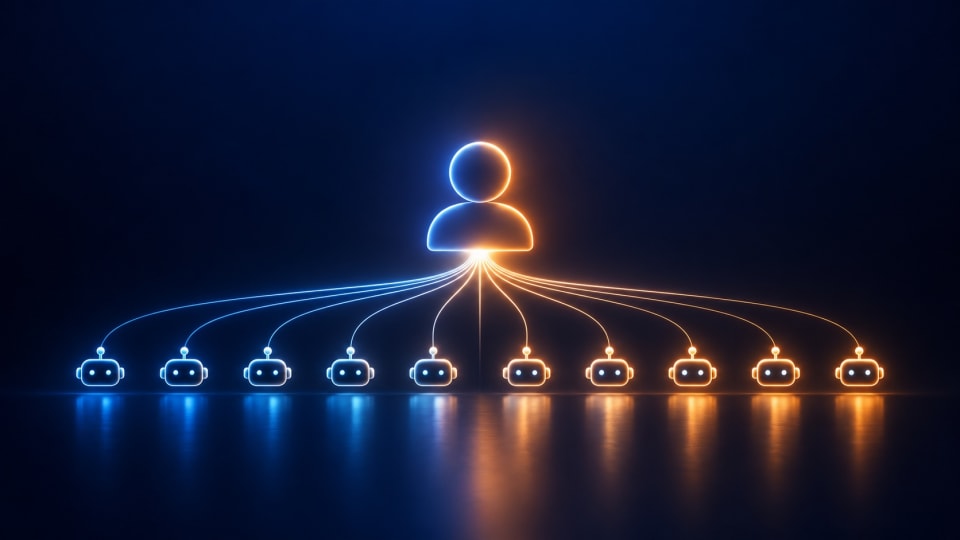
Could One Employee Soon Manage 20 AI Workers?
Imagine opening your laptop in the morning and checking on a team of 20 workers.
One researched competitors overnight. Another prepared a sales report. Three worked on software. Another monitored customer requests.
None of them are human.
That may sound extreme, but AI is already moving in that direction.
People Are Starting to Manage Teams of AI Agents
OpenAI says some of its most advanced business users have already moved from asking AI for help to managing teams of agents that complete work for them. Multi-agent systems can divide a large project between specialized agents working simultaneously. See OpenAI’s view of the next phase of enterprise AI
That changes the employee’s job from doing every task personally to setting goals, assigning work, and reviewing results.
One Person Could Suddenly Have Much More Capacity
An AI worker does not need to handle only one task at a time.
Different agents could research customers, analyze documents, monitor systems, prepare reports, write software, or update business tools simultaneously.
Microsoft’s 2026 Work Trend Index found that active agents in Microsoft 365 grew 15 times year over year, while advanced users increasingly delegate routine execution to AI and focus more on judgment and direction. Read Microsoft’s 2026 Work Trend Index
Managing AI Workers Could Become a Real Skill
The challenge will not simply be creating more agents.
Someone still needs to decide:
-
What each agent is allowed to do
-
Which tasks require human approval
-
How results are checked
-
What happens when an agent makes a mistake
-
Which systems and data each agent can access
Microsoft already manages visibility across more than 500,000 agents inside its own organization, showing how quickly agent management can become an operational problem at scale. See how Microsoft manages its AI agents
Your Next Team Might Include Humans and AI
Twenty AI workers per employee may not become normal tomorrow. But the direction is becoming clearer.
People may increasingly spend less time executing every step themselves and more time directing, reviewing, and coordinating AI agents.
At Sparkfire Solutions, we build Sparkfire AI, Sparkfire automation, and Sparkfire software around real business workflows, helping teams use AI agents with clear permissions, human oversight, and measurable goals. Explore more Sparkfire solutions at sparkfire.us.
FAQs
What are AI workers?
AI workers are agents designed to complete business tasks and workflows.
Can one person manage multiple AI agents?
Yes, multi-agent systems already allow several agents to work in parallel.
What is AI agent orchestration?
It coordinates tasks, tools, and handoffs between multiple AI agents.
Will AI agents replace employees?
Some tasks may shift to agents, while people focus more on judgment and oversight.
Why is human oversight important?
Humans still need to review important decisions, permissions, and outcomes.